Water quality guide
The Complete Guide to Tankless Under-Sink Reverse Osmosis Systems
How multi-stage tankless under-sink RO systems work, what professional installation involves, and how to tell whether one fits your kitchen.
Updated August 4, 2026 · 11 min read · Blink H2O
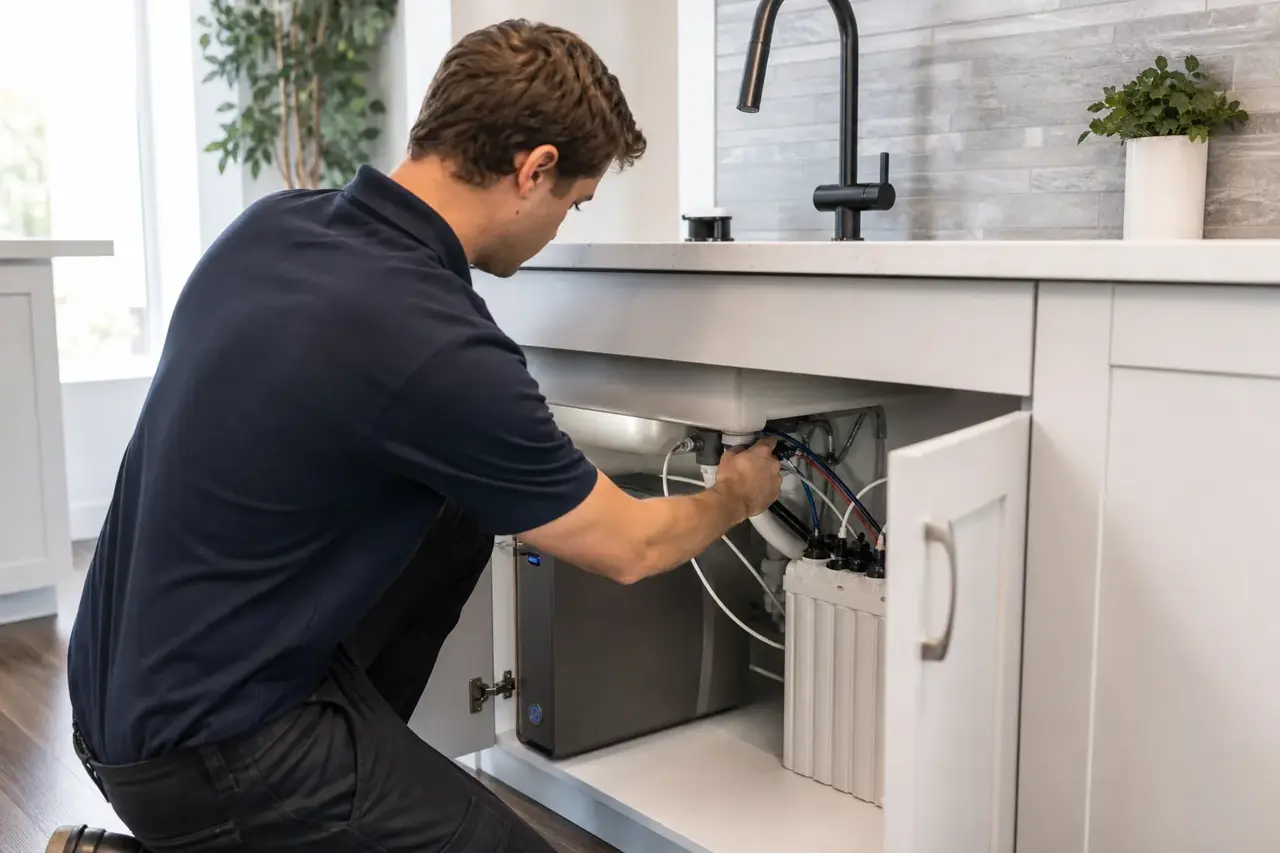
Access to clean, high-quality drinking water at home should not require refilling bulky countertop pitchers or sacrificing valuable under-sink cabinet space. A tankless under-sink reverse osmosis (RO) system offers a streamlined, modern solution that delivers purified water directly at your kitchen sink on demand.
Here is a complete look at how multi-stage tankless RO systems work, what professional installation involves, and how homeowners and renters can determine the right fit for their kitchen.
What is a tankless multi-stage RO system?
A tankless reverse osmosis system is a dedicated point-of-use filtration setup that treats water through multiple stages before it reaches a specialized drinking-water faucet.
Water first passes through sediment and carbon pre-filters to capture larger particles, chlorine and sediments. Next, it is forced through a semi-permeable reverse osmosis membrane, which removes microscopic contaminants, heavy metals and dissolved solids. Additional post-filtration stages then polish the finished water to enhance taste and clarity.
Unlike conventional RO units, a tankless design does not rely on a large, pressurized 3- to 4-gallon storage tank beneath the sink. Instead, the compact filtration unit treats water on demand whenever you open the dedicated faucet, preserving valuable cabinet space. If you want the stage-by-stage detail, see how reverse osmosis works.
Why homeowners choose tankless under-sink RO
Choosing an under-sink system provides targeted water purification right where daily consumption happens.
- Cleaner use of cabinet space: without a traditional pressurized tank taking up room, the under-sink cabinet remains open and easy to organize for bins, cleaning supplies and plumbing access.
- Water for everyday routines: treated water is readily accessible on tap for drinking, filling kettles, brewing coffee, preparing meals and mixing baby formula without waiting for refrigerator pitchers to refill.
- Dedicated point-of-use setup: treating water specifically at the kitchen sink is far more efficient and practical than whole-home treatment when your main priority is kitchen drinking water.
What should you consider before choosing a system?
Before arranging an under-sink RO installation, take a few minutes to consider how the system will fit your kitchen layout and routines.
- Available cabinet space: the unit must fit comfortably beneath the sink with enough clearance around the drain, shut-off valves and existing plumbing for future filter replacements.
- Faucet placement: RO systems are typically paired with a dedicated drinking-water faucet. Check whether your sink or countertop layout allows for installation or has an existing opening.
- Household usage: consider how many people will use the filtered water and whether it will be limited to drinking or also used for cooking and beverages.
- Maintenance access: filters must be changed as part of normal ownership. The unit should remain easily accessible rather than packed tightly behind stored items.
- Landlord approval: renters should obtain landlord approval before arranging an installation, particularly if the setup requires a new faucet opening or changes to plumbing connections.
- Existing kitchen setup: sink layout, water supply and drain connections all impact how an installation is completed. A professional installer can assess these conditions rather than relying solely on exterior dimensions.
How does professional RO installation typically work?
Professional installation ensures leak-free performance, proper water pressure and secure integration with your kitchen plumbing. A standard installation follows six steps.
- Review the installation area. The installer examines the under-sink cabinet, water supply, drain connections and the intended location of the drinking-water faucet.
- Confirm the system layout. Filtration stages, tubing and connections are arranged so the unit operates properly without creating unnecessary strain or obstructing cabinet access.
- Install the dedicated faucet. The faucet is securely mounted to provide a convenient, dedicated point of use for treated water.
- Connect the water and drain lines. The installer makes the required supply and drain connections, ensuring all components are secure and properly aligned.
- Test the installation. The system is pressurized and inspected thoroughly for leaks, flow rate and proper shut-off operation before work is completed.
- Explain routine care. The technician explains how each filter functions, when replacements are due and how to maintain easy cabinet access for ongoing care.
For a longer walkthrough of the appointment itself, read what happens on install day.
What should you expect from system maintenance?
Reverse osmosis systems require ongoing filter changes to protect the internal membrane and maintain the quality of the water produced. When comparing systems, look beyond the upfront hardware cost.
- Confirm what replacement filters are required and how often they need attention.
- Ensure the unit is installed where it can be reached easily for filter servicing.
- Keep the cabinet area clear enough to spot potential leaks and access housings quickly.
- Pay attention to changes in water flow, taste or pressure, and arrange service if anything seems unusual.
Tankless RO solutions in the Waterloo Region: Blink H2O
For households in Kitchener-Waterloo, Cambridge, Guelph and surrounding communities, Blink H2O supplies and professionally installs compact multi-stage tankless under-sink reverse osmosis systems.
To eliminate guesswork, Blink H2O provides a fixed all-in price that includes:
- The multi-stage tankless RO system
- Complete professional installation
- All first-year replacement filters
- A 1-year workmanship warranty covering the installation
This all-in-one approach gives homeowners and approved renters a clear starting point without hidden fees or surprise maintenance costs during their first year. The full breakdown is on the pricing page.
Choose the right next step for your kitchen
Use these questions to guide your decision.
- Where will the unit, tubing and connections fit beneath your sink?
- Do you have a suitable location for the dedicated faucet?
- Will the treated water be used for drinking, cooking and beverages?
- Can the system remain accessible for routine filter changes?
- If renting, do you have landlord approval?
- Is your goal a dedicated kitchen point-of-use solution rather than whole-home treatment?
If your priority is clean, reliable kitchen drinking water and a streamlined under-sink space, a tankless RO system is an ideal choice. Talk to Blink H2O to discuss your setup and schedule your professional installation. We serve Kitchener, Waterloo, Cambridge and Guelph.